

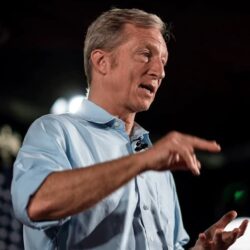

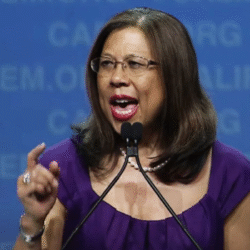
If, like me, you’ve spent any time in the trenches of California politics over the last 45 years, the current 2026 Governor’s race feels like a fever dream you’ve had before. We are staring down a “Top-Two” math problem that looks a lot like the wreckage of 2003 and 2006, and if the Democratic establishment isn’t careful, we’re about to repeat our worst mistakes.
With Eric Swalwell officially out and the primary ballots already hitting mailboxes across 58 counties, the “chaos” phase is over. We are now in the survival phase.
The Ghosts of Recalls Past: 2003 and 2006 primary election
To understand the danger of today, we have to remember the two different ways we’ve blown it before.
In 2003, the party was paralyzed by the “Bustamante Blunder.” We tried to have it both ways: telling voters to “Vote No on the Recall” while simultaneously running a backup candidate. That “No on Recall, Yes on Cruz” message was a disaster of mixed signals that left our replacement candidate standing in a field of 135 others with a fractured base. We let Arnold Schwarzenegger walk into the Governor’s mansion because we couldn’t commit to a single, coherent strategy.
In 2006, we pivoted from paralysis to a “Suicide Pact.” Labor hitched its wagon to Phil Angelides because of seniority and loyalty, ignoring his massive “unfavorables.” We spent $80 million of Democratic and Labor money just to beat each other up, leaving the winner too bloodied to survive the general against a “post-partisan” Arnold.
The Battle for the Boots: SEIU, CTA, and the Trades
Strategy is great, but in a June primary with historically low turnout, logistics win. We aren’t just waiting for voters to choose; we’re waiting to see which “army” gets mobilized.
-
The SEIU Juggernaut: With 700,000 members, SEIU California is the undisputed heavyweight of door-knocking. Their “orphaned” field operation—left vacant after rescinding their Swalwell endorsement—is the most valuable prize in the state. If they move to Porter, she gets an instant statewide ground game.
-
The CTA’s Trusted Messengers: The 310,000 members of the California Teachers Association are in every ZIP code. When a teacher knocks on a door, DTS (Decline to State) voters listen.
-
The Building Trades: Representing 500,000 workers, the Trades have a long-standing “green-job” alliance with Steyer.
The California Labor Federation has the power to coordinate these groups into a unified front. But if they remain split—or worse, if they try to deploy these elite ground troops to “build” a candidate like Betty Yee from 2% to 16% in just seven weeks—they are effectively disarming the Democratic party.
The “Trump Factor” and the 2026 Math
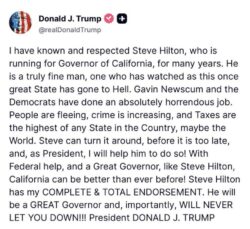 Last week, Donald Trump officially weighed in, giving Steve Hilton his “Complete and Total Endorsement.” In any other state, that’s a death knell for Democrats. In California’s 2026 primary math, it’s a strategic hand grenade.
Trump’s endorsement of Hilton is designed to break the Republican tie between Hilton and Riverside Sheriff Chad Bianco. By siphoning Bianco’s support to Hilton, Trump is raising the floor for the GOP. However, for us, it changes the “entry fee” for the Top Two. If Hilton clears the field and takes 22%, the second-place slot could be won with as little as 14%.
But don’t be fooled: a lower threshold actually makes the race more dangerous for Democrats. It encourages candidates like Katie Porter and Tom Steyer to stay in a high-decibel fight, keeping our vote split three or four ways while a lingering Bianco sneaks into second place.
The Impact on the Field: Yee, Porter, and Steyer
The Trump endorsement forces each candidate into a new role:
-
For Betty Yee: My heart is with Betty, but Trump has nationalized this race. In a high-volume partisan brawl, the “steady administrator” brand gets drowned out. Without a massive, unified surge from Labor, Yee remains at a mathematical disadvantage that risks a total party lockout.
-
For Katie Porter: The endorsement gives her a perfect villain. She can use her “whiteboard” to attack the Trump-Hilton alliance, keeping her base energized. But energy doesn’t pay for the airwaves needed to reach the 25% of undecided voters.
-
For Tom Steyer: He is the “new beast” in this jungle. Unlike Meg Whitman, he’s spent 15 years funding labor. He has the only tool that can counter the Trump-Hilton noise: unlimited liquidity. He can define himself to the DTS (Decline to State) block as the “Firewall” before the GOP can define him as an elitist.
The “Resume” Candidates and the Spoiler Effect
 Beyond the frontrunners, we have a field of “Heavyweights on Paper” who, in any other year, would be formidable. But in 2026, they are caught in a statistical no-man’s-land. Xavier Becerra has the strongest CV in the race as HHS Secretary and former CA Attorney General, yet he’s stalled at 5%. Antonio Villaraigosa is leaning into his “problem-solver” brand but is struggling to break out of the single digits at 4%. Meanwhile, Tony Thurmond and Matt Mahan remain serious public servants, but both sit below 4% in recent polling.
Wait, Why Yee Over Becerra? Some might ask why I’ve included Betty Yee in the “Big Three” while Becerra technically polls higher. The answer is in the Convention Math. Yee walked out of the CADEM Convention with 17.3% of the delegate vote, beating Becerra and nearly doubling Porter. In a low-turnout June primary, delegate support is a “coiled spring” that tells you where the ground game will land. Becerra has the name ID, but Yee has the heart of the organizing machinery.
The “Cold Math” Reality: Every percentage point these candidates pull from the “Swalwell Vacuum”—the orphaned voters left behind by Eric Swalwell’s withdrawal—is a point that isn’t going toward consolidating a Democrat into the Top Two. While these candidates are highly relevant on a resume, their primary role in this specific primary is acting as unintentional spoilers. By fragmenting the Democratic base, they are lowering the ceiling for the frontrunners and inadvertently helping Hilton and Bianco cruise into November.
The Final Strategic Play
 To avoid a repeat of 2003’s mixed signals and 2006’s bloodbath, we need a “Cold Math” strategy:
-
If Labor Unifies: They must fall mostly behind Katie Porter immediately. This allows Democratic voters to safely split between Porter and Steyer, ensuring at least one clears the hurdle.
-
The Non-Aggression Pact: Labor must avoid attacking Steyer. He is the most palatable choice for the DTS voters. Attacking him only subsidizes Hilton and Bianco.
-
The Defensive Fail-Safe: If Labor does not make this move—if they remain fractured or try to prop up a non-viable candidate—then the best choice for undecided Democrats and Democrat-leaning DTS voters is to vote for Tom Steyer. He alone has the money to communicate his way past the Trump-backed surge and ensure a Democrat is on the ballot in November.
The 2026 Governor’s race isn’t in November; it’s on June 2nd. It’s time to trade our “ideal” picks for a strategy that actually works. If we don’t, we’ll be watching the General Election from the sidelines.
Author’s Note: I retired to the South of France in early 2025, and can no longer vote in California elections. That, however, does not mitigate my concern for the political future of my home of 45 years. Hence, I am submitting my thoughts for those of you who can vote to consider.
Steve and Tom both opted out of the voluntary campaign spending limit of $11,767,000 (source CA SOS).
Thank you for sharing your thoughts.
No one really jump out for me so I am waiting to see how things shake out. I will make my decision in May.