


Three members of the Irvine City Council are asking the city manager to begin discussions about adding Ranked Choice Voting to the city charter for the 2028 elections. They make an argument that RCV will results in candidates who win the majority instead of a plurality of voters and will result in clean, more honest campaigns.
Here’s the memo from Council members Melinda Liu, Kathleen Treseder and Betty Martinez-Franco:
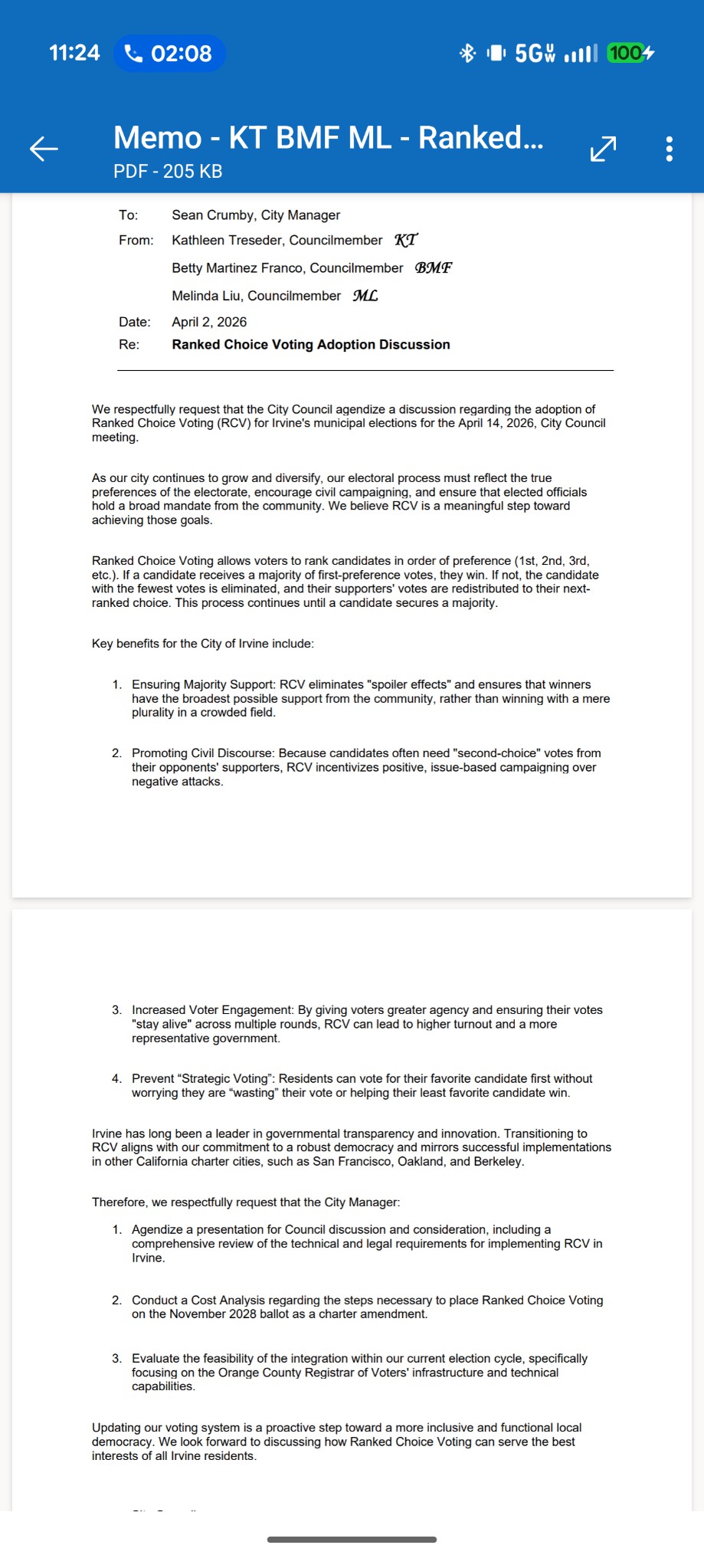
I think this is a bad idea that overly complicates voting. And in some cases, a Republican who should have lost wins and vice versa. Until moving to district elections in 2024, plurality winners made it to city council. We got it. It was rare for a council candidate or a mayoral candidate with several competitors to get a majority. But the system worked then as it does now. Ranked Choice Voting always struck me as the solution for someone who lost the first round of voting but is convinced they’d win on a second or third round. Nice try.
Here’s my argument against RCV.
Ranked choice voting (RCV) is pitched as the electoral equivalent of upgrading from a flip phone to a smartphone—sleeker, smarter, and better. It fixes everything. Its proponents speak in glowing terms about “majority support,” “eliminating spoilers,” and “more civil campaigns.” Bullshit. Dig deeper and ranked choice voting starts to look less like a democratic innovation and more like a well-intentioned overcomplication that introduces as many problems as it solves.
For most voters, RCV is confusing. Yes, just because you just rank candidates in order of preference, doesn’t make it simple once votes are actually counted. The tabulation process—where the lowest-ranked candidates are eliminated in rounds and their votes redistributed—quickly becomes a procedural labyrinth. For the average voter, understanding how their vote ultimately contributes to the final outcome requires either a flowchart or blind faith. Neither is exactly a hallmark of transparent democracy.
Elections are supposed to be straightforward: the candidate with the most votes wins. You don’t need a background in statistics to grasp the result.
RCV outcomes can feel opaque and even counterintuitive. A candidate who leads in first-choice votes on election night can end up losing after multiple rounds of redistribution. That may be mathematically defensible, but politically, it’s a tough sell. When voters feel like the system is playing tricks on them, trust erodes—and trust, once lost is hard to regain.
Advocates claim RCV empowers voters by giving them more choices. There’s actually plenty of evidence it discourages engagement. Some voters simply don’t complete all the rankings, either because they’re unfamiliar with all the candidates or because they don’t want to inadvertently help someone they dislike. These “exhausted ballots” (votes that no longer count in later rounds) mean that the eventual “majority winner” may not actually have majority support from all voters who showed up—just from those whose ballots survived the process. So much for one voter one vote.
RCV also assumes that voters have both the time and inclination to carefully evaluate a long list of candidates. Expecting them to rank five or six candidates in a meaningful way is optimistic at best. At worst, it leads to arbitrary or poorly informed rankings, which undermines the very idea that RCV produces a more thoughtful electorate.
One of the selling points of RCV is that it eliminates “gaming the system.” I call bullshit again. Strategic voting doesn’t disappear—it just gets more complicated. Voters may still try to anticipate how others will rank candidates and adjust their own ballots accordingly. Campaigns, meanwhile, must navigate a bizarre hybrid of appealing for first-choice votes while also angling to be everyone’s second or third favorite. The result? Messaging that can feel watered down, overly cautious, or just plain confusing — and it gets much more expensive for campaigns to manage multiple messages to second and third or fourth choice voters. “Vote for me at #3!”
RCV’s ability to reduce negative campaigning is… aspirational at best. If you think that’s not true, may I sell you a bridge in Brooklyn? Politics is still politics. Differences in policy, ideology, and competence don’t magically disappear because voters can rank preferences. If anything, the need to appeal broadly can lead to vague, noncommittal platforms that prioritize likability over substance — a Tammy Kim campaign!
There’s going to be a high cost to add RCV. Implementing this process isn’t free. It often requires new voting equipment, updated software, voter education campaigns, and more complex ballot-counting procedures. Jurisdictions adopting RCV have had to spend significant sums to make the transition, all for a system whose benefits remain hotly debated. Can Irvine convice the ROV to pour money into a more complicated voting method thta other communities haven’t adopted? Or will Irvine bear the cost to do this.
And please consider a real “what if” scenario. Close elections under RCV can and will trigger recounts that are even more complex (and expensive) than standard ones. Imagine trying to re-run multiple rounds of vote redistribution under intense scrutiny and tight deadlines. It’s not exactly a recipe for swift or universally accepted results. Election integrity is already under a microscope, and RCV just adds layers of complexity that taxpayers don’t need.
Proponents of RCV is that its hailed as a cure for polarization. By encouraging candidates to seek broader support, elections will become less divisive (hahahahahaha). Changing how ballots are counted doesn’t suddenly make people agree on key, critical issues. If anything, the frustration and confusion surrounding RCV outcomes jusy adds to political discontent.
Democracy works best when it’s simple, accessible and intuitive. RCV demands voters think like political analysts, ranking hypothetical preferences and anticipating outcomes. It’s a big ask for the general public.
RCV promises clarity, fairness, and consensus. Instead, it will delivers confusion, ambiguity, and unintended consequences. It asks voters to do more, understand more, and trust more—all while making the process harder to follow.
So yes, ranked choice voting sounds great in theory. But in practice, it’s a reminder that sometimes the simplest systems endure for a reason—and that adding complexity to something as fundamental as voting might not be the upgrade it’s cracked up to be. Irvine voters should hold on to the system we use now. I’m not interested in being represented by someone who was most voter’s second choice.
Lastly: In every city council election held, only one candidate was elected with more than 50% of the vote. And that was council member Mike Carroll with 57.94% in 2024.
What utter hogwash! You can’t have a system in which it’s possible for the winner to be the person the majority least wanted to gain office and call it a democracy. But that’s precisely what our current system allows.
RCV is not all the complicated. Understand ranking? Sure. Everyone ranks all the time. Understand runoff elections? Sure. They’ve been around forever. This is just a series of instant runoff elections. Only like a single candidate? Just vote for that one only. Only like two? Just rank those two.
The only reason anyone would prefer the current system is that they somehow benefit from minority rule. I find that intolerable. RCV gives the electorate the ability to speak in full sentences and ensure the best possible mandate for an election winner.
Gosh, even the Woodbridge HS students understand that Ranked Choice Voting is a more democratic way to vote — they use RCV for their student government elections. 🙂 If students at the high school level can understand the advantages of RCV, I’m sure the greater Irvine voter population can too.