
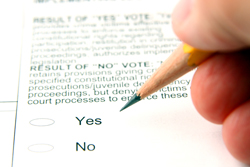

Tonight, the Irvine City Council will hear from a well-organized effort from Democrats of Greater Irvine to call for the city to change the way we elect public officials — and the way 99.98% of all states, counties, cities, villages, towns and hamlets elect public officials — for Ranked Choice Voting which would guarantee the winner of any election somehow garners 50% of the vote even if it’s not the voter’s original choice.
This is like winning the March Madness pool even though the team you thought would win in all didn’t and no one else got the right team, but you have more points in the Sweet 16 than everyone else.
DGI’s Mari Fuji wrote a wonderful document of talking points for RCV and it’s compelling. I take issue with this one:
- We use RCV in everyday decision-making, constantly “ranking” priorities in our busy lives – what to eat, where to shop, what to buy. RCV is a natural extension of what we do when we have to “rank” choices with limited time or money.
One of the more creative arguments being used to sell Ranked Choice Voting (RCV) is that it mirrors the decisions we make every day. You’ve probably heard the examples by now: You have a favorite restaurant, but it’s closed, so you choose another. Your preferred vacation destination is too expensive, so you book your second choice. Five of you want to see a movie, but no one can agree. Therefore, the argument goes, ranking candidates on a ballot is simply how life works.
It’s a clever talking point.
It’s also nonsense.
The problem is that voting in a public election is not remotely comparable to deciding where to get tacos on a Tuesday night.
When voters enter the voting booth, they are making a deliberate choice about who should govern their city, county, state, or country. They aren’t ordering from a menu. They aren’t selecting backup dinner plans. They are choosing the people who will spend public money, make laws, negotiate contracts, and set policy.
Life, of course, has a way of disrupting plans. Clients make impossible last-minute demands. Employers call with emergencies. Cars break down. Health crises arise. Flights get canceled. Kids get sick. Those are situations where circumstances force people to adjust.
But an election isn’t supposed to be a crisis-management exercise.
The entire premise of democracy is that voters make a choice. If they don’t get their preferred outcome, that’s because other voters made different choices—not because their first-choice candidate was somehow “out of stock” and they need to move down the list to Option B.
Imagine applying the same logic elsewhere.
Your favorite baseball team loses? Congratulations, you’ve automatically become a fan of your second-favorite team.
Your preferred college rejects you? No problem, we’ll assume you’re equally enthusiastic about your fourth-choice school.
Your spouse leaves you? Don’t worry, we’ve already ranked your next five preferred replacements.
Suddenly the “that’s how life works” argument doesn’t sound nearly as persuasive.
The irony is that many of the same people promoting RCV as a more democratic system seem remarkably uninterested in letting voters decide whether they want it in the first place. That’s where the real contradiction emerges.
If Ranked Choice Voting is such a superior democratic reform, why not put it on the ballot and let the public vote on it?
After all, local governments routinely ask voters to weigh in on taxes, bonds, infrastructure projects, public safety spending, housing initiatives, and countless other issues. Cities spend millions of dollars on projects that require voter approval. New parks, libraries, transportation improvements, and tax increases often go directly to the electorate. Yet somehow, changing the fundamental method by which citizens elect their leaders is treated as an administrative detail that can simply be imposed from above. That’s an odd definition of democracy.
Supporters frequently describe RCV as empowering voters. If that’s true, shouldn’t voters be empowered to decide whether they want the system at all?
Instead, the public is often told that experts know best. City councils know best. Consultants know best. Election reform advocates know best.
The voters? They’ll learn to love it later.
Nothing says “democratic reform” quite like skipping the democratic part.
What’s particularly amusing is that local governments often agonize over public outreach for relatively minor decisions. There are workshops, surveys, stakeholder meetings, focus groups, environmental reviews, and public hearings. Entire bureaucracies spring into action to gather community input on park benches, bike lanes, landscaping plans, and parking restrictions. But when it comes to redesigning the voting system itself, suddenly public consent becomes optional. Apparently democracy is critically important—right up until the moment voters might be asked what they think about changing democracy.
Supporters insist that RCV produces better outcomes, encourages civility, and gives voters more choices. Maybe those arguments persuade some people and maybe they don’t. Reasonable people can disagree. What shouldn’t be controversial is the idea that voters deserve a say before politicians alter the rules governing elections. That’s not an argument against Ranked Choice Voting. It’s an argument for actual choice.
Because if advocates truly believe RCV represents the future of democracy, they should have enough confidence in the idea to let voters decide.
And if the public chooses something else?
Well, according to the logic of ranked-choice advocates, there are always second choices.
https://irvine.granicus.com/player/clip/7383?redirect=true
Starting at 5:27:30 the RCV item is presented. It’s going to a city vote.
What does Arkansas, Florida, Idaho, Indiana, Iowa, Kansas, Kentucky, Louisiana, Mississippi, Missouri, Montana, North Dakota, Oklahoma, South Dakota, Tennessee, West Virginia and Wyoming have in common?
They all have BANNED Ranked Choice Voting
I’m chuckling a bit. The notion that Irvine campaigns would be nicer if we adopt RCV? Hysterical. The nastiness on this current council is horrible. The new Democratic majority is responsble for significant financial mistakes. Why does Irvine’s council members need a staff of six?
Pammy, and they are all shit hole states with bad healthcare, terrible public education, and are an economic drain (Fed subsidy welfare states). So… that’s for making a great case FOR RCV.
First of all, RCV is only in .02% of all USA municipalities — states, counties, cities, villages, towns and hamlets and that’s not counting school boards, so making these points against RCV as Republican talking points ins’t true at all. The notion that campaigns will be nicer is not going to happen in Irvine. The idea this will someone encourage voting by young people is laughable — young people should be voting but they don’t because they need a perfect candidate. When referencing the cost of adding RCV, you all seemed to forget that OC’s voting hardware and software are not enabled for RCV so all the costs of helping the county will be bourne by Irvine and the cost for Minneapolis (about 60,000 more residents than us) was $430,000 a few years back. Maybe the new council majority can fire some of those staffers they all have added in the past few years to help Irvine cover costs.
Dan, you and your handlers are going to lose this RCV battle. There is too much grassroots support and willing volunteers to allow special interests to defeat this. Go ahead. You, Agran, Suhkee, Strader, TIC, OCGOP, some other shadowy right winger or organization can throw money at this battle, but you all will lose this one. We are mobilizing and we will do substantial door knocking, fliering, email blasts, DGI mobilizations, workshops, non-profit support, ect. Come at us bro. We are ready to go to war.
My handlers? I have no handers. I talk to Agran a couple of times a year and haven’t chatted with him about RCV. I talk to Sukhee about his campaign and let him know that Evette Kim wrote a nasty ageist post about him on Instagram (claimed he was 85) and confirmed through the city she was on the clock when she did so in violation of city policy on social media. Strader threatened to sue me years ago when I published a voice mail message he left for a council member. I ran it, he didn’t sue because the city released it. I don’t have a single contact at the Irvine Company. Not one. OC GOP? I have some friends on that committee but they don’t live in Irvine. I admire your ability to fantasize who my connections are or aren’t. But given how excited your side was that the city council could enact it without letting the voters decide only to change your position and request it be added to the ballot was popcorn fodder. Glad your came around to have voters decide if they want it. Now here’s a question for you — what will you do when you lose this fight? Five of the seven members of this city council has less than four years of experience and it shows with how they spend money foolishly. And siz members of the council were elected with less than 50%m– Treseder at 22%. Anthony Kuo would have been elected twice with RCV – in 2022 and 2025. Mike Carroll is the only one of the council elected with more than 50% of the vote.
and since you’re making up shit out of whole cloth and your a city commissioner, can you confirm you are employed by ICE as a lawyer which Eric here keeps yammering about.
And of Melinda Liu, Willima Go and Dr. Treseder, who knew that Tammy Kim wasn’t living in District 3 and instead was lying about her District 5 resident?
Dhs not ice. Supervisory immigration services officer Jeremy Ficarola reporting for duty.
Thanks for clearly laying out the GOP arguments against RCV courtesy of your friend Jubal. Shouldn’t you give Matt credit for writing this?
It is not full of misspellings, missing words, and terrible grammar, so it is clearly not the work of Dan.
I fixed a few typos after I posted. Matt hasn’t written about this as far as I know. And hard to call this GOP talking points when RCV is in.02% of all municipalities. But where’s the data on claims RCV results in better representation, greater turnout, and nicer campaigns?
It’s all anecdotal Dan.
At the June 9th, council meeting, RCV was item #5.1. At the 10:45 p.m. point, the Mayor determined how to finish the meeting. There were about 15 commenters wearing purple CalRCV shirts, and members of Sunrise and FairVote. Many of these were not Irvine residents. Agran moved agenda items 5.2, 5.3 and included a break before hearing 5.1. The RCV item started at 11:35. Then Agran and Melching decided to waive reading the Lawyer’s report. Reports were presented for every other item that evening. Is there a legal rule for not reading the report?
The more importment thing is now RCV will be on the ballot; it was fun waching those who cheered that the council could just make it happen without a voye of the people then beg the council to put it on the ballot. It will lead to nicer campaigns? Sure. Look at how nasty the NYC Mayor’s race was last year. Greater turnout? No. Critical issues alwasys lead to better turnout. RCV is how we live everyday? No. I start every day with a calendar of meetings and a list of things I have to do. Then boom; something disrupts my choices and priorities for the day. Ryan Dack used pizza toppings to try and explain RCV; a better example is 6 friends want to go to the movies…4 decide to see a RomCom while you wants to see an ation thriller. And you get stuck seeing a movie you had no interest in but your friends out-voted you.