

By turning Letitia Clark’s support for peaceful protest into an attack on her public-safety record, Tustin’s mayoral campaign risks becoming a case study in the politics of racial division.
There is a legitimate debate to be had about public safety in Tustin. Voters can disagree about policing, budgets, crime prevention, and how local government should respond when racial tensions erupt. What they should not have to do is sort through campaign mailers that blur the line between political disagreement and misleading insinuation.
That is precisely the controversy confronting Tustin’s 2026 mayoral race, where former Mayor Letitia Clark has been targeted by negative campaign mailers connecting her to the movement to defund the police. Clark has rejected that characterization, arguing that her actions following the 2020 murder of George Floyd were about peaceful demonstrations, racial justice, and constructive community dialogue—not cutting police funding.
Mayor Austin Lumbard, who is seeking reelection on November 3, owes Tustin voters a straightforward answer: Are these attacks an honest representation of Clark’s record, or are they designed to make voters fear a candidate by associating her with a politically toxic label?
The distinction matters. And so does the racial context.
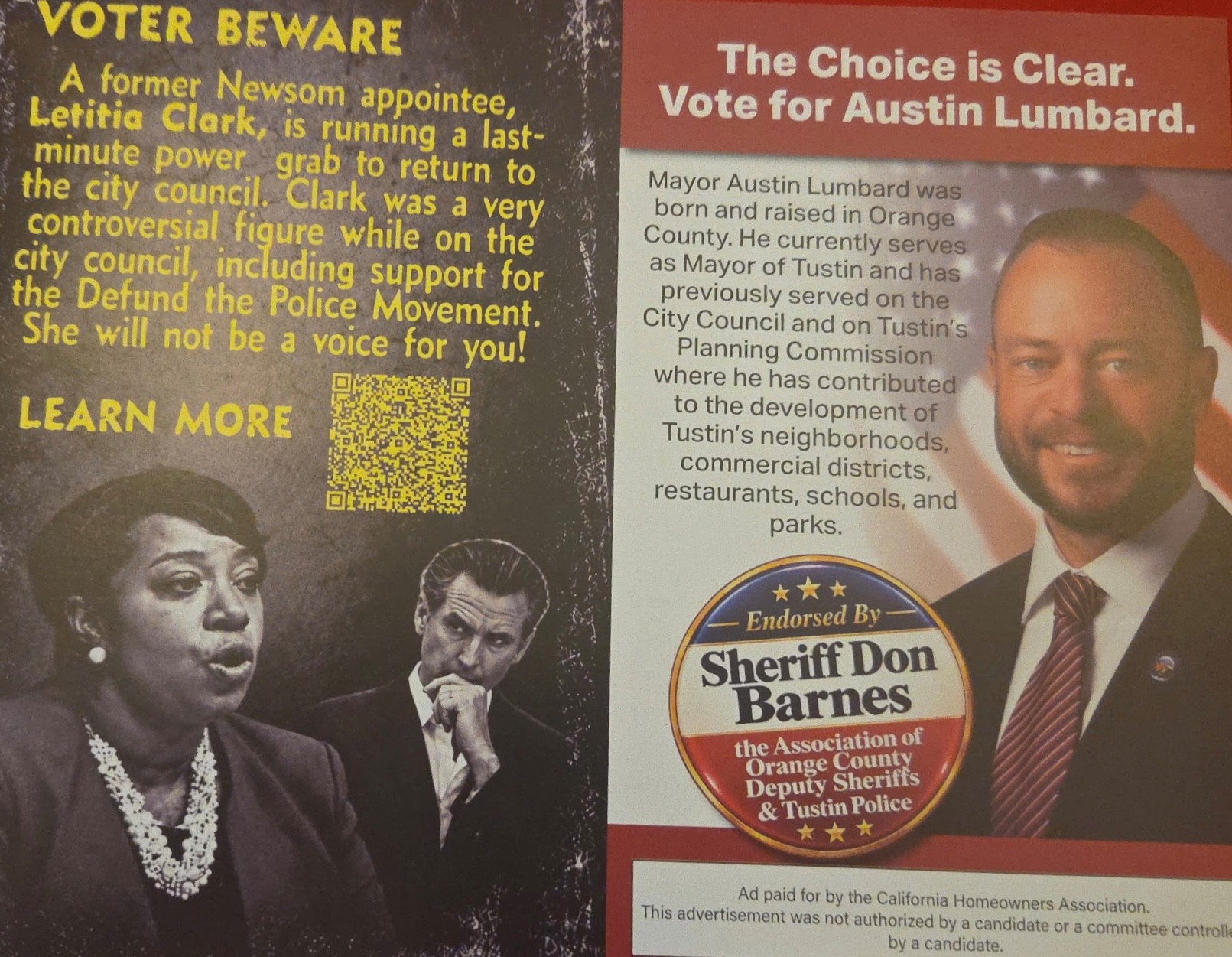
Peaceful protest is not the same as defunding the police
The murder of George Floyd in May 2020 sparked a national reckoning over policing, racial justice, and the relationship between law enforcement and the communities officers serve. Local officials across the country faced difficult questions about how to protect public safety while respecting residents’ constitutional rights to protest and express their views.
Tustin was no exception.
Clark’s involvement in discussions about peaceful demonstrations and community relations is now being used against her in a mayoral campaign. But supporting peaceful protest does not automatically mean supporting the defunding of police departments. Nor does an interest in racial justice establish hostility toward law enforcement.
Those are separate questions, and voters deserve evidence rather than insinuation.
Clark’s current campaign platform explicitly calls for continued investment in public safety, emergency preparedness, and mental health services. That does not settle every question about her past positions, but it underscores why voters should examine her actual record and statements instead of accepting a campaign mailer’s characterization at face value.
If Lumbard’s campaign believes Clark advocated specific cuts to police funding, it should identify the statements, proposals, or votes that substantiate the claim. If it cannot, the public deserves to know why such a serious allegation is being circulated.
The most troubling aspect of this controversy is not simply that a candidate is being attacked. Negative campaigning is hardly new. It is that a discussion about racial justice and peaceful protest can be repackaged as evidence that a candidate is dangerous or unsympathetic to public safety. That tactic deserves scrutiny, particularly when directed at a Black woman seeking the city’s highest elected office. There is a difference between criticizing a candidate’s policy decisions and using associations with racial justice movements to cast suspicion on her fitness to lead. The latter can reinforce racial stereotypes, particularly when a candidate’s support for community dialogue is presented as evidence of hostility toward police without persuasive supporting evidence. The effect can be to make engagement with racial justice itself a political liability.
That is why the question of racism cannot simply be dismissed as an overreaction to hardball campaigning. A campaign need not use an explicit racial slur to employ messaging that exploits racial anxieties. At the same time, determining whether a campaign is intentionally racist requires evidence about its content, context, and origins—not merely the fact that its tactics are offensive. Based on the allegations surrounding these mailers, it is fair to ask whether Lumbard’s reelection effort is exploiting racial divisions for political advantage. It is not responsible to declare the campaign’s intent conclusively established without knowing who produced and authorized the mailers and what evidence they relied upon. The mayor should not be allowed to evade those questions.
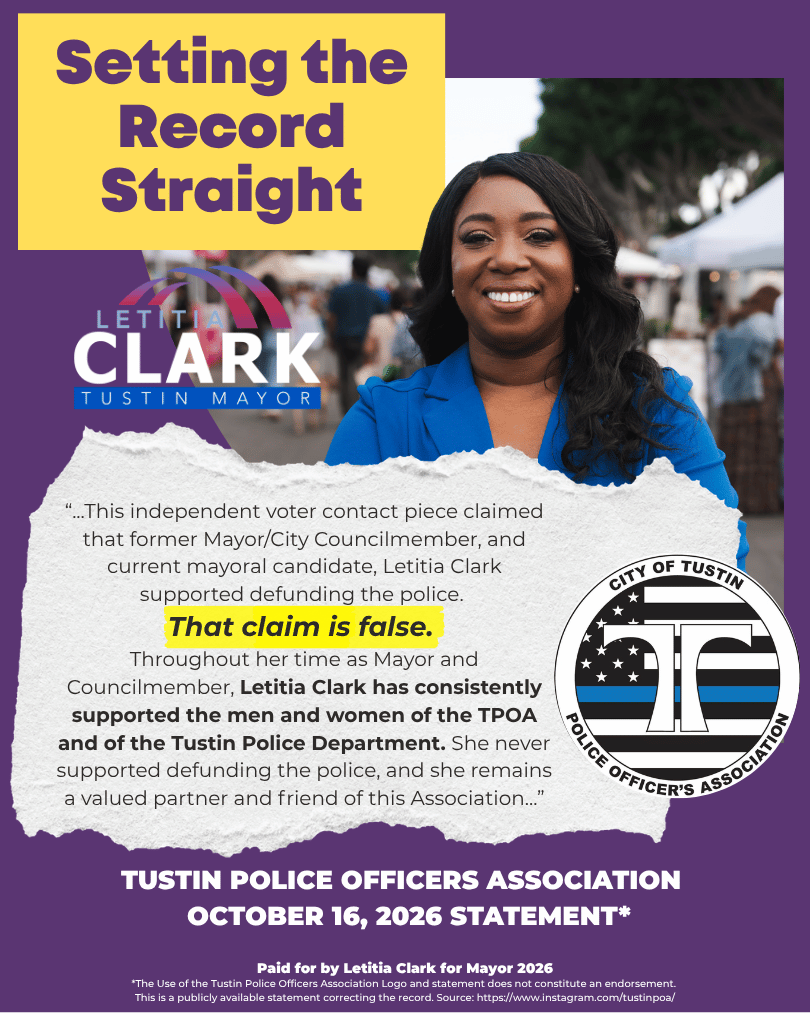
The Tustin Police Officers Association’s response is particularly relevant because the disputed mailers concern Clark’s relationship with law enforcement.
According to the account of the controversy provided for this article, the association disputed the claim linking Clark to defunding the police. That response warrants careful examination: If the organization representing Tustin police officers has challenged the central premise of an attack on Clark’s public-safety record, the campaign should explain why it continues to advance that allegation. The association’s precise public statement should be reviewed before drawing conclusions about the scope of its disagreement. Nevertheless, its reported response makes one thing clear: Voters should not accept a sweeping accusation about Clark’s position on policing without examining the underlying evidence. Public safety is too important to become a prop in a campaign built around unsubstantiated labels.
The controversy spilled into public discussion at the October 20, 2026, City Council meeting. The meeting is available through the City of Tustin’s official video archive.
According to accounts of the public-comment period, residents voiced frustration with negative campaigning, questioned the accuracy of political advertisements, and called for greater civility and accountability from candidates and elected officials. Their concerns reflect a basic expectation of local government: Candidates should debate the issues facing residents rather than inflame divisions through questionable personal attacks.
Tustin has real decisions to make about public safety, economic development, infrastructure, housing, and the future of its neighborhoods. Residents should be hearing competing plans for those challenges—not being asked to judge a candidate through the lens of a disputed political label. Lumbard, as the incumbent mayor, has a particular responsibility to explain the standards his reelection campaign follows. Leadership means more than claiming credit for the city’s accomplishments. It also means being willing to answer difficult questions when the integrity of a campaign is challenged.
If the mailers are accurate, the evidence should be readily available. If they distort Clark’s record, the campaign should correct the record. Silence is not an adequate substitute for accountability.
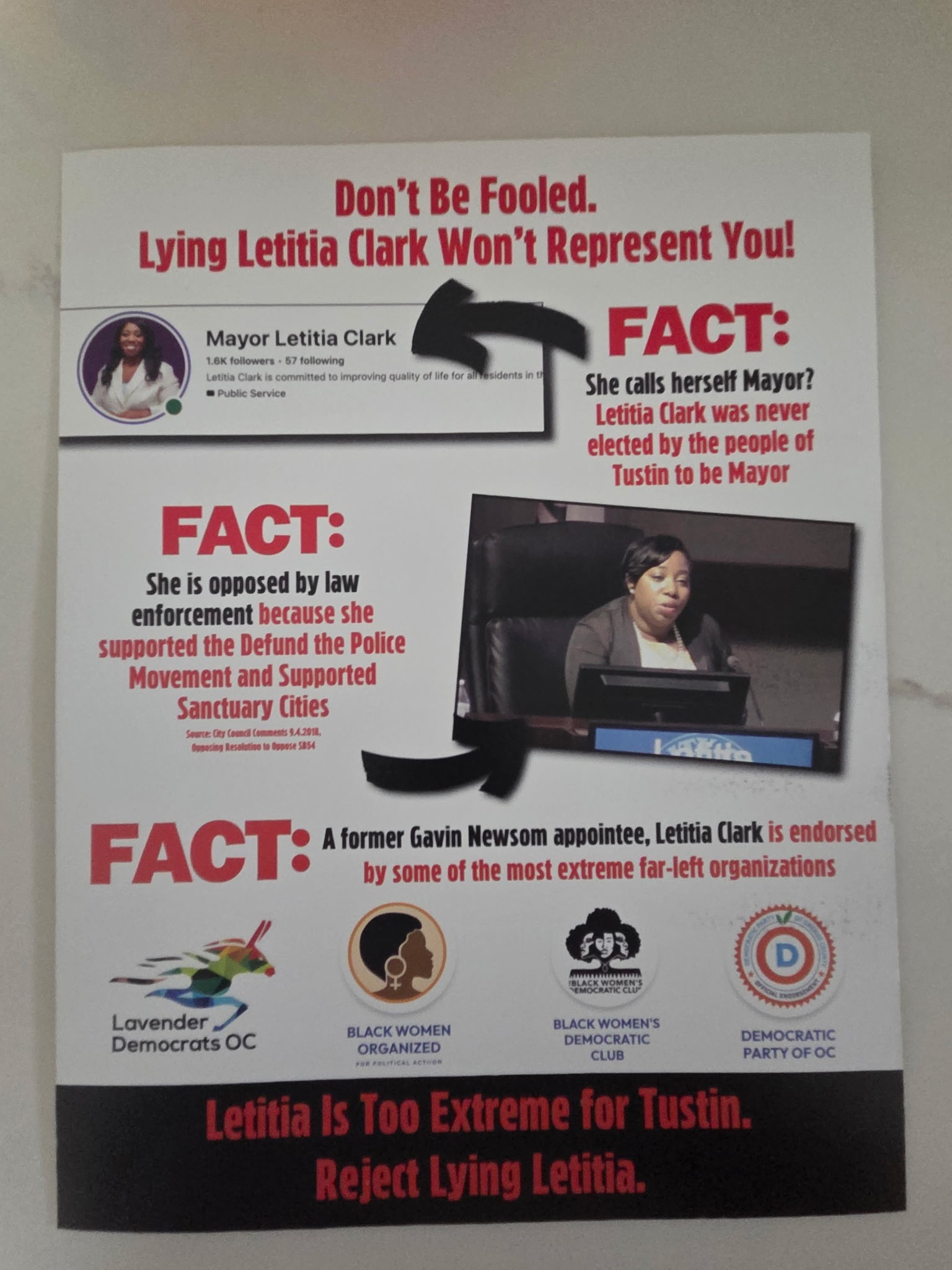
Check out the organization’s he Lumbard campaigns says are extreme; and, Tustin began directly electing its Mayor in 2024, so using Lumbard’s logic, Tustin voters did not elect any of their awful Republican mayors either. What a surprise that will be to Jerry Amante or Al Murray.
This election should be about the kind of leadership Tustin needs, not whether a candidate can be politically damaged by her association with peaceful protest or racial justice. Clark’s record should be scrutinized. So should Lumbard’s. Neither candidate deserves a free pass, and neither should be judged by claims that cannot withstand examination.
But there is a fundamental difference between tough political debate and an effort to mislead voters about an opponent’s positions. If the allegations surrounding these mailers are substantiated, Lumbard’s campaign will have to answer for tactics that undermine public trust and risk exploiting racial divisions. Tustin voters should insist on that accountability now, before they cast their ballots.
A mayoral campaign is a test of character as well as policy. The question is not whether Austin Lumbard can attack Letitia Clark. It is whether he can defend the honesty and integrity of the campaign he is running. I don’t think he has. And it’s revealed his character. Tustin deserves an answer. And its voters should look at each candidate’s character and decide who they trust more. My business is in Old Town and has been since 2014. I trust Clark.
Leave a Reply